
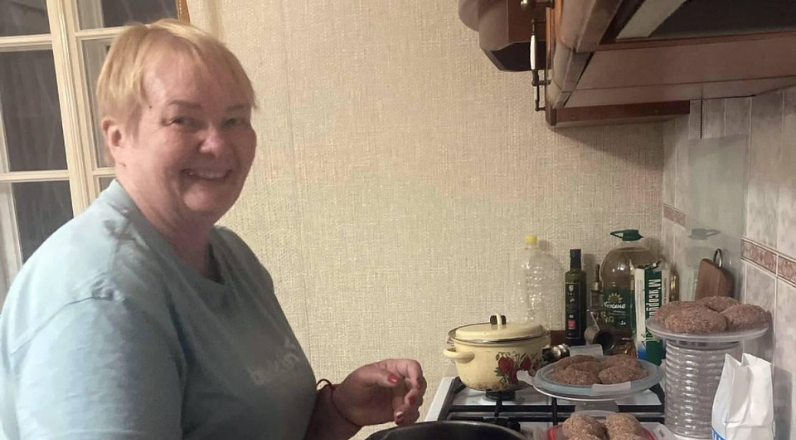
Elena Meshcheryakova nearly died from COVID, survived repression by law enforcers, and was forced to leave the country. When Russia attacked Ukraine, she became a volunteer, but now she needs help herself.
My name is Elena Meshcheryakova. I am 60 years old. Before I was forced to emigrate, I lived in the town of Uzda, Minsk Region. I worked as a forewoman and senior forewoman at the Volat-1 enterprise, then as the head of a carpentry workshop and a construction forewoman in Ratomka, and later at the Mingaz unitary enterprise in Minsk.
Ahead of the 2020 election, I registered as an independent observer with the Honest People initiative group. On August 5, I was detained near a polling station on fabricated charges. Later, I was sentenced to seven days of administrative detention. At the temporary detention centre, a female police officer beat me on the legs with a baton because I refused to take off my cross and bra.
After my release, I continued taking part in marches, solidarity actions, and protests, and I was also a member of the Coordination Council of the town of Uzda.
Soon afterwards, I became seriously ill with COVID-19. My lungs were 67% affected, I was in intensive care and underwent lengthy treatment. The day after I was discharged, law enforcers came to my home again. I did not open the door and told them that I was Elena’s sister and that she was staying with family members. They eventually believed me and left. To make sure their car was no longer near the house, I rushed outside to check, and only on my way back did I realise that I was walking through the snow wearing nothing but socks on my feet. I was frightened.
I called my son, and we decided that I needed to leave urgently. I had only three hours to pack. My son was only able to give me 400 Belarusian rubles. I exchanged them for approximately €156 and left with a single bag, heading into the unknown.
That is how I ended up in Latvia. After a lengthy procedure, I received refugee status and began rebuilding my life. The consequences of the beating began to take their toll: the blood vessels in my legs had been seriously damaged. I needed surgery. I saved money for two years and eventually managed to have the operation.
When Russia’s full-scale war against Ukraine began, I realised that I could not stay on the sidelines. During my holidays, I went as a volunteer to the Lanka rehabilitation centre, which a fellow Belarusian woman had opened for Ukrainian defenders. I helped in the kitchen, took care of everyday practical matters, and tried to make sure that the fighters recovering from their injuries felt cared for and supported.
My boss did not like my trips, even though I made them during my holidays, so I had to quit my job. I then registered with the employment office, completed Latvian language courses, and throughout this time continued travelling to Ukraine as a volunteer.
During one of these trips, physical exertion caused a back injury and a pinched nerve. I received first aid in Ukraine, but I could not continue treatment there, so I returned to Latvia on strong painkillers.
I spent a week in hospital (I could not afford to stay any longer), and I also did not have enough money for further rehabilitation. For several months, I recovered with virtually no proper medical care. Because of my illness, I lost my income and accumulated rent debt.
Today, my condition continues to deteriorate. Examinations have shown that I have a chronic spinal condition and stage II–III coxarthrosis of the hip joint.
Doctors warn that the disease of the hip joint is progressing rapidly. Under the state programme, I may have to wait around two and a half years for surgery, but according to specialists, I no longer have that much time.
I currently work in a shop stocking shelves, but my salary is only enough to cover the most essential expenses. I cannot pay for housing, my debt, medical examinations, and treatment all at the same time.
I live alone in Latvia. My parents passed away in 2019 – they died on the same day. In 2021, my sister died of COVID-19 in Minsk. I have a son, but he is in Belarus and, unfortunately, cannot help me. It has always been easier for me to help others than to ask for help for myself. But today I have found myself in a situation that I can no longer cope with on my own. I am afraid of losing my home, and I am afraid that the disease will leave me unable to walk independently or work.
Fundraiser amount:
€5,552
€2,875 – cementless hip replacement surgery
€2,281 – cementless hip joint prosthesis with a ceramic-on-ceramic bearing
€264 – general anaesthesia
€132 – plexus anaesthesia